



“The classroom belongs to everyone.”
When Lara, an Early Childhood Educator, says this to her class, her students pick up the concept of shared resources and spaces. They understand in a classroom environment, they play a key part in the upkeep.
The same goes for the home environment. A home is the place where every child is entitled to feel safe emotionally and physically. Naturally, a safe home environment comes with a sense of belonging.
In today’s post, we’re looking at 4 household tasks you can do with your children at home, through two lenses:
The developmental appropriateness of each task, from Lara | The Parenting Tree.
And my practical how-to, through my experience as a certified KonMari home organizing consultant and connection-first parenting.
Lara is also sharing 4 more tasks on her account to help your children develop their sense of belonging through helping to take care of the home. The link will be available at the end of the post for you to continue learning from this collaboration.
We look forward to any questions or comments on what your experience is like trying out these ideas.
💗 Ann and Lara
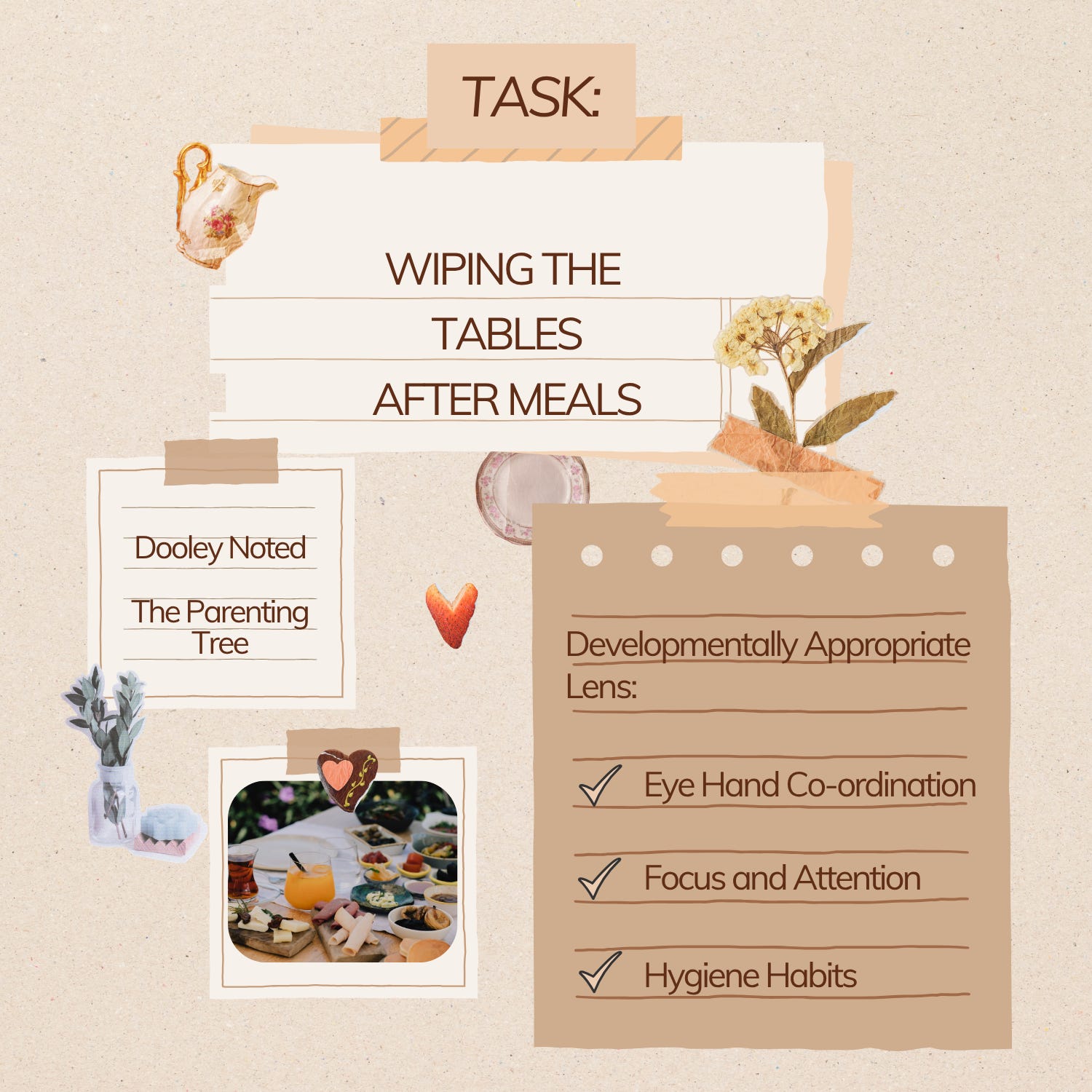
Wiping the Tables After Meals
The Approach by Ann:
Set up a little table-wiping tool kit: Place a set under the sink, in a small caddy or on hooks attached to the cabinet door, keep a spray bottle and cloth. It’s easy for them to reach, and it gives them a real sense of ownership over the task.
Turn it into a game: Name the mission something like “Mission Zappers,” where the goal is to zap every splat and spot. Giving it that kind of name encourages kids to notice the mess and take action to complete it.
Developmental Lens by Lara:
The task of wiping tables isn’t as simple for children as it is for adults. They require a sense of balance and some eye-hand co-ordination when they move the cloth around the table surface. Stubborn stains removal may require them to exert more strength.
Focus and attention gets developed when they spot areas that are particularly dirty. Tasking children with the wiping of tables also nurtures a habit of keeping their space clean and tidy.
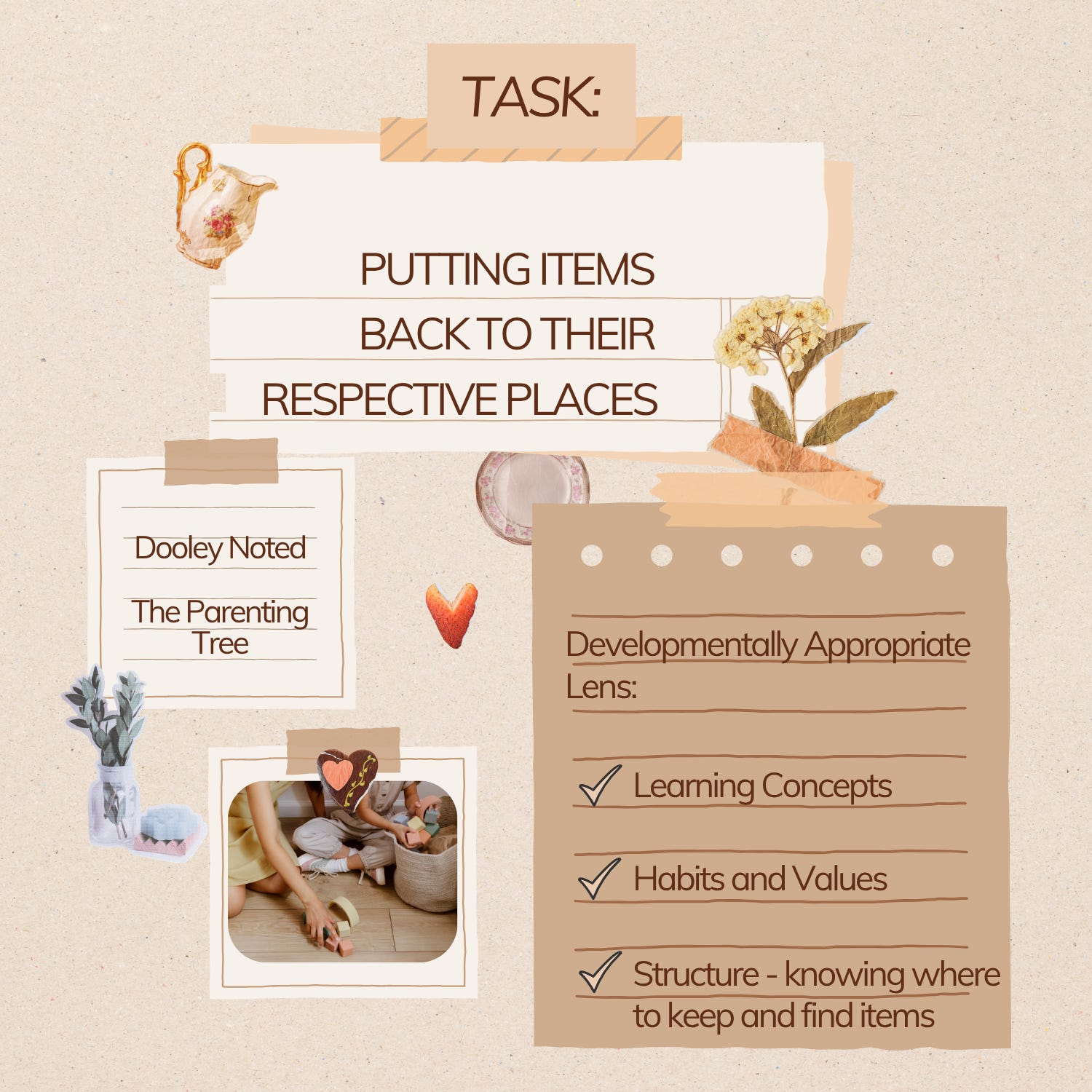
Putting Items Back to Their Respective Places
The Approach by Ann:
Children get excited when a game has a time limit.
Set a timer and play a round of “I Spy”: Focus on just one category at a time, and place each item in its designated container. Reset the timer for the next group of items. This makes play part of the transition to the next item on the schedule.Put things away by adding movement: Each round, call out an animal and have the kids pretend to hop like a rabbit, tiptoe like a mouse, or stomp like an elephant, swinging their arm like a trunk while picking up the toys. Name a new set of animals each day to keep it exciting.
Developmental Lens by Lara:
Putting items back to their respective places is a little tricky - we need to be mindful of their ages.
Toddlers may be able to put things back on the shelf, but we can’t expect them to keep the items in their “spot”. Invite them to do it anyway!
The younger children would still very much enjoy bringing the items, one at a time, towards the shelves and placing them on it. We just need to remember to provision more time.
For the older children, this task is definitely manageable and it covers some learning areas too! A different way to learn the concept of matching (visual labels would be extremely helpful here), and spatial awareness.
We are instilling values of responsibility and care towards their space and environment. When children know where things are kept, they’d also know where to retrieve them. This develops a sense of autonomy and in the long term, builds a sense of agency and resourcefulness.
Bonus: It supports parents: less hand-holding when your child knows where to retrieve items from and put back.
Have you set up any of these stations in your homes? Share them with us!
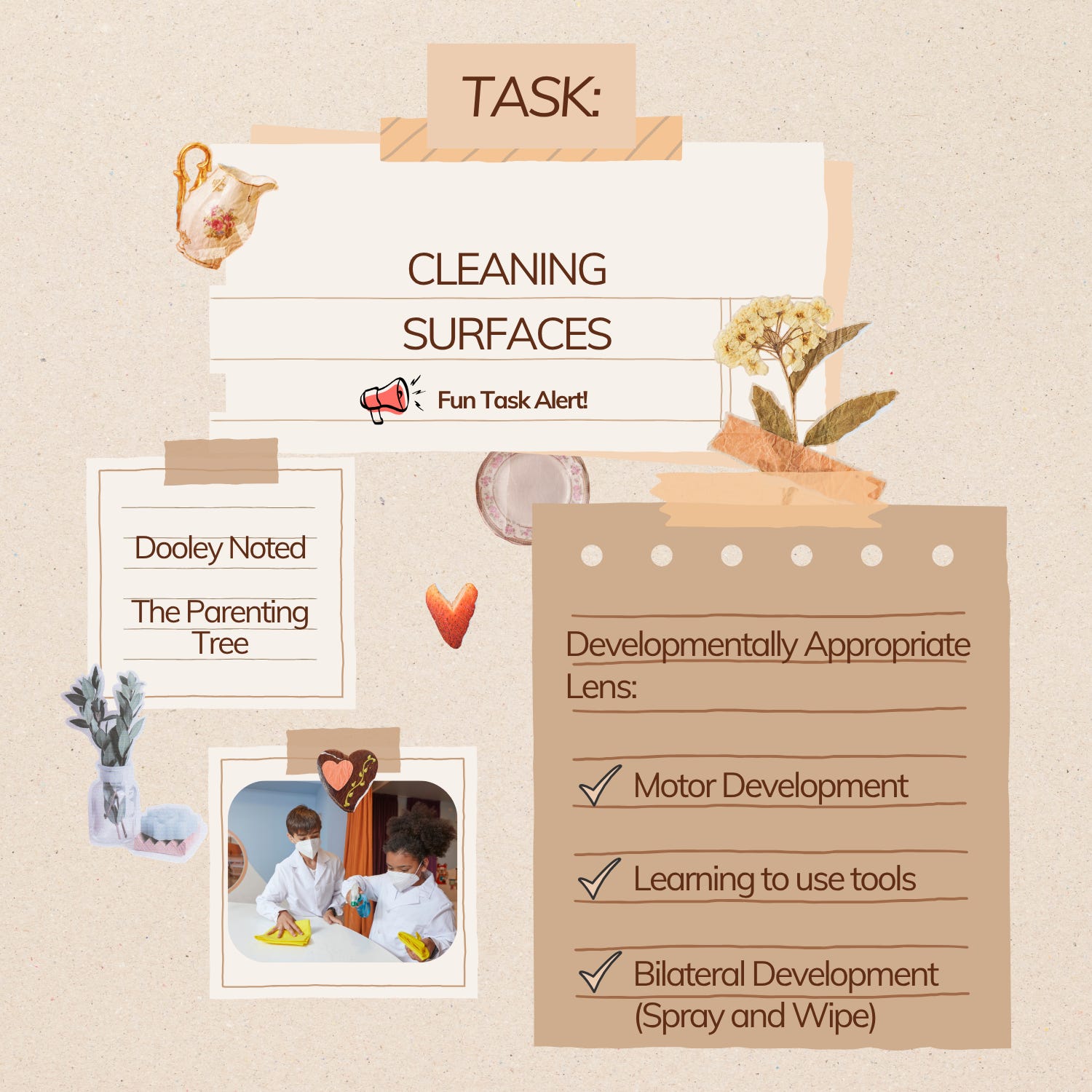
Cleaning Surfaces
The Approach:
Set up a little bathroom kit similar to the dining table one — a spray bottle with a simple vinegar-and-water solution and a soft cloth, kept where they can reach on their own.
My work with families is about building character, and wiping the mirror is a unique chance for that. While they clean, have them practice saying something true about themselves with each wipe — “I am confident,” “I am strong,” “I am a helper” — or anything else that reflects how they see themselves.
Developmental Lens by Lara:
This may seem like a task, but it’s definitely a fun one for children!
Gross and fine motor development takes place here - similar to wiping the tables. The spray bottle itself is a tool to be manipulated. Different textures of cloth produce different cleaning outcomes and it’s an opportunity for them to practice observing and concluding.
Recently (on social media), there seems to be an increased interest in bilateral co-ordination activities. Here, we have 1 hand in charge of the spray bottle, 1 hand in charge of wiping. Step by step, one after the other. Loads of co-ordination going on!
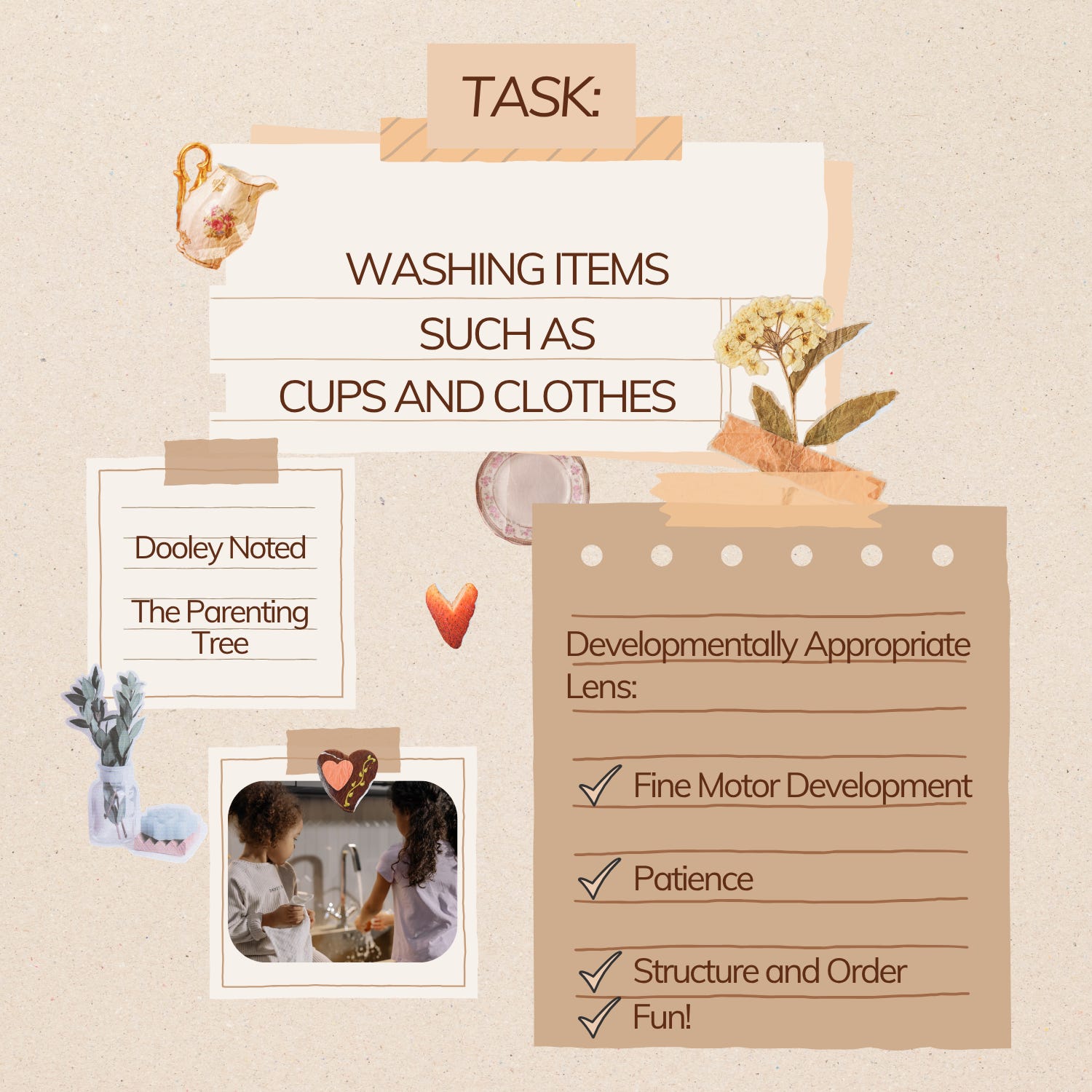
Washing Items Such as Cups and Clothes
The Approach by Ann:
For dishes and cups: offer sponges, cleaning brushes, and washcloths, and dilute dish soap with water in a pump bottle. Let them play from there — the goal is simply to work off the bubbles and see if everything comes out squeaky clean.
For clothing, like small hand towels or socks: show them how to rub the fabric together and wring the water into another bucket, turning it into a challenge to see how much they can fill it up.
Developmental Lens by Lara:
A good water-play alternative, if you ask me. Children love water play, but sometimes we may not be able to provide them with the full experience of splashing around. Give them a task! They’ll enjoy it equally, with a different approach. Clear boundaries should be communicated - this is a task that they need to complete.
Take this opportunity to observe them! Are they the type to wash one cloth, squeeze dry, then hang and peg? Or are they leaning towards washing all the cloth, squeezing them all dry and hanging all together?
The task requires them to activate their fine motor skills, and have patience in repetitive tasks.
4 more tasks in Lara’s Post →
The common thread through this list is that these skills don’t stop at “childhood” - they’re skills your child will carry through life. And when they’re introduced as part of the norm, rather than as an instruction or task, the resistance fades, and the energy around it shifts too.
These skills shape the quality of our everyday lives, and sometimes as adults, they even recharge us.
Whether it’s through the lens of an Early Childhood Educator or a KonMari home organizing consultant, the view of these everyday tasks as more than chores is the same. We believe they are moments of connection, capability, and belonging - one small task at a time.
Read Ann and Lara’s previous collaboration here:

Children’s involvement in chores
Lara | The Parenting Tree and Dooley Noted
·
Aug 30

Children’s involvement in household tasks
·
Aug 31
About Ann Dooley, Dooley Noted
Ann is a connection-first home organizer who believes cooperation begins with connection.
She works with overwhelmed parents reduce the stress and friction caused by clutter by creating homes where everyone can participate and work together.
With nearly a decade of experience guiding families, Ann’s approach goes beyond creating order. She believes children learn through play, and when they feel seen, heard, and connected, cooperation can happen naturally.
Her goal isn’t simply a more organized home. It’s a home where families feel confident working together, with more room for generosity, creativity, kindness, and the things they value most.
About Lara | The Parenting Tree
Lara is an early childhood educator who writes about early childhood (behaviour, connection, resilience, and everything in between) to help parents understand themselves and who their children are a little better.
She writes The Parenting Tree and, Dear Child…- two spaces for sharing reflections that help us meet children, and ourselves, a little more clearly.