


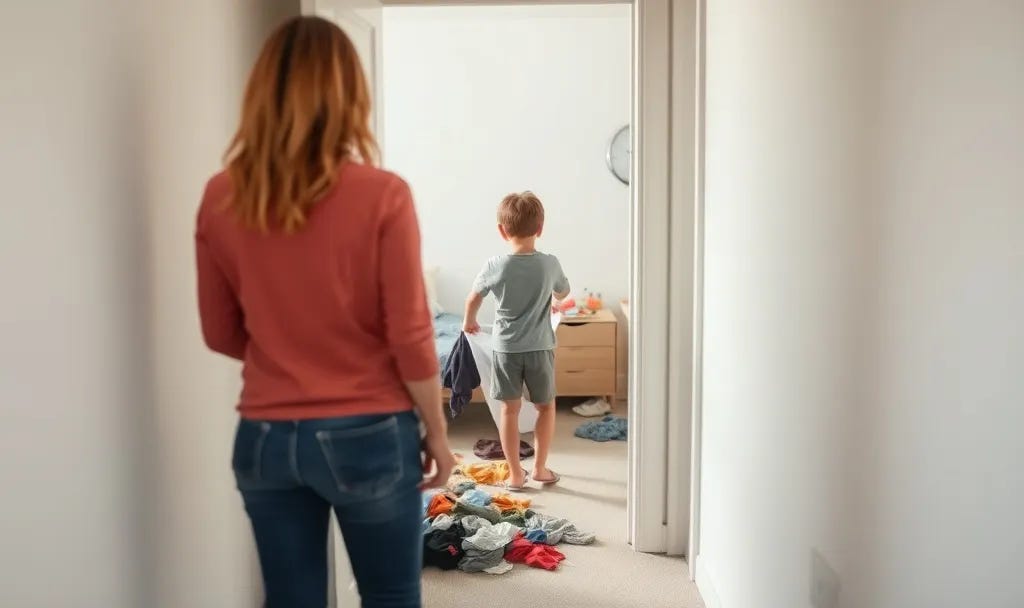
Walking past my kids’ bedroom, I noticed their dirty laundry on the floor.
When they were young, I thought nothing of it and would place the clothes in the hamper myself. As time went by, the same pile kept appearing. I started to ask, “Can you guys pick that up? Put it in the hamper, okay?”
Then I watched them walk past it. Again and again.
So I tried a reward chart. For about a week, it worked. Then the novelty wore off, and I found myself reminding my son to check the chart. Now I was keeping track of two things: the laundry, and the system that was supposed to take care of the laundry.
I’ll admit, my discomfort wasn’t only about the mess. It was the conflict between wanting them to take initiative and not wanting to have to repeat myself.
Because I know how it usually goes: a kid waits until you get tired of asking calmly, and you start coming down on them harder. That’s when the clothes finally land in the hamper. But that kind of motivation, based on fear, doesn’t develop anything lasting.
Motivation coming from inside is different. It’s a kid noticing the pile and acting because something in them wants to. Either they feel the benefit themselves, or they feel a sense of pride in their own abilities.
The older they get, the more that gap matters. The more autonomy they want, the less patience they have for being managed, even into something as small as a hamper.
Here’s what that’s looked like across the ages, in our house.
Act One - The Reluctant Toddler
My youngest had a big toy car collection. At the end of playtime, “clean it up” landed nowhere. He’d go quiet, or push back, or just keep playing like he hadn’t heard me.
One day, instead of asking him to clean up, I got down next to him and asked what the cars were up to. Turned out there was a whole story running — a race, a rescue, cars waiting their turn. I was surprised and delighted to learn how big of a world he was creating inside of his head.
“That makes sense you don’t want to clean up. You’re having a lot of fun.”
He nodded. “I wish there’s more time to play too.” I softened my gaze.
Then, excited, I said, “I have an idea!” I grabbed a small notepad, folded it in half, and drew a quick sign: Harry’s Parking Garage.
"Can you be in charge of running the garage and make sure every car is parked by closing time?" I checked the clock and set our visual timer for 10 minutes. "You've got this," I said, and shook his hand. "You take care of the garage, and I'll take care of dinner. I'll see you at the table."
A smile appeared. He started to line up the cars one by one. He wasn’t motivated by the cars going away. He was motivated by having a little bit of power in that moment, running his own garage, which became part of his routine.
Act Two - The Overwhelmed 6-Year-Old
Markers, plates from an after-school snacks, a granola bar wrapper, a couple of toy trains, a handful of coins, and a bunch of loose drawings on his desk.
He knew it was time to clear it off. Today, his shoulders slumped, and he groaned, “There’s too much stuff!”
I was overwhelmed too.
I sat down next to him and put a hand gently on his shoulder. “That’s a lot to look at all at once,” I said. “Where do you want to start?”
He shrugged, so I offered him two options: “Trash first, or the coins?” He picked trash. Wrapper in the trash can, then the plate to the dishwasher. “What’s next, the trains?” I asked.
I offered a little assistance but let him take the lead. He worked his way across his desk from left to right. By the time he got to the markers and drawings, his energy shifted as well. He put away the last few items on his own and was surprised it went by quickly.
Act Three - The Independent Tween
He knew because we’ve talked about this — that one day, his laundry would be all on him, no reminders needed. Today was that day.
He stood at the machine for a second, not moving. Then he started sorting, talking himself through it under his breath. “Dark, dark... light...”
I stayed close enough, but doing my own thing so I wouldn’t draw any attention.
Once he finished sorting, he completed the rest of the steps then piled the cleaned laundry onto the couch. He knows how to fold because he’s been practicing for years. But I sat with him and grabbed all the socks. It was our time to talk while getting things done, together.
What works:
These situations happened over the course of my sons’ childhood. I’ve hit some roadblocks but one thing became clear: rewards and threats don’t actually teach responsibility. They teach compliance, which most often turns into a negotiation, with both of us getting upset.
What built true cooperation and self-reliance was trust, patience, and the right kind of support at the right moment. And I’ve turned what I learned into three tools inside the Dooley Method:
C.A.R.E. stands for Connect, Acknowledge, Resolve, Empower. It’s how we lean into a child’s “no” and find the reason underneath it.
Let’s say a child feels unsure about a task and says, “No, I can’t do it.”
We connect first, noticing the fight-or-flight response and softening our expression and tone to find out what they’re feeling.
We acknowledge what’s there: “It makes sense that you feel...”
We resolve by lowering the risk without taking over: “I’m here for you. We can figure this out together.”
And we empower once it’s done: “You did it. You must feel so proud of yourself.”
S.H.I.N.E. stands for Seen, Heard, Independent, Nurtured, Engaged. It’s what children need to feel while they’re learning life skills and becoming self-sufficient. Here are a few examples:
When a child feels seen, it can sound like: “Wow, your room looks so organized. You must have worked hard at it.”
Nurturing shows up in the harder moments: “That must be frustrating when the toys don’t fit right. Where else can we try?”
And engagement is the invitation forward: “You’ve gotten really fast at folding socks. Ready to try t-shirts? I think you are.”
Another tool I use to motivate children is coming up with acronyms for a task that takes a few steps to complete. For example:
S.W.A.S.H. stands for Sort, Wash, Add detergent, Switch to the dryer, Help with folding or hanging.
You can make up your own for any task with a few steps. Its purpose is to help children build self-reliance until the steps become second nature. Younger kids may need visuals placed where the task happens. Over time they work their way toward remembering the steps on their own.
I’ve spent the last eight years helping frustrated parents calmly gain their kids’ cooperation with these Dooley Method tools.
Imagine your toddler putting away their toys before coming to the dinner table. Or your child, going through a growth spurt, placing a shirt that no longer fits into a bin, without you telling them to.
How would you feel if, six months from now, nagging or yelling weren’t part of how cleanup happens?
In my own home, when I finally stopped the approach my parents used, fear as the motivation, I noticed the tension in my body lift.
I felt more confident in how I was showing up for my kids, and putting connection first meant I got curious about where my stress and their anxiety were coming from.
I wasn’t afraid to lean in when they had a hard time, and through patience and empathy, reached outcomes I never expected were possible without yelling.
If you’ve been pushing through on your own, I’d love to help. Reply and let me know what’s been hardest, or DM me anytime with questions.
❤️
The Developing Internal Motivation lesson below covers:
The 3 tools above in detail
More fun ways to motivate toddlers and young kids, how to reach teens
How to build motivation through routines and visual and verbal cues.