



Last week, Sheeba shared the first story in our series, to illustrate the challenges of letting go. Many of you resonated with the story, and we appreciated the comments. If you haven’t had a chance to read it, I hope you’ll save it for later.
And in case you aren’t familiar with Sheeba of This, Right Here, we connected over motherhood and our shared curiosity in what it really means to let go. In this series, Sheeba tells a fictional story each week, inspired by South Indian family life. Afterwards, I bring my real life perspective as a connection-first home organizer and parent educator to offer some practical applications.
This week’s story is about Nikita, the Keeper. We hope you enjoy reading it.
Nikita, the Keeper
by Sheeba
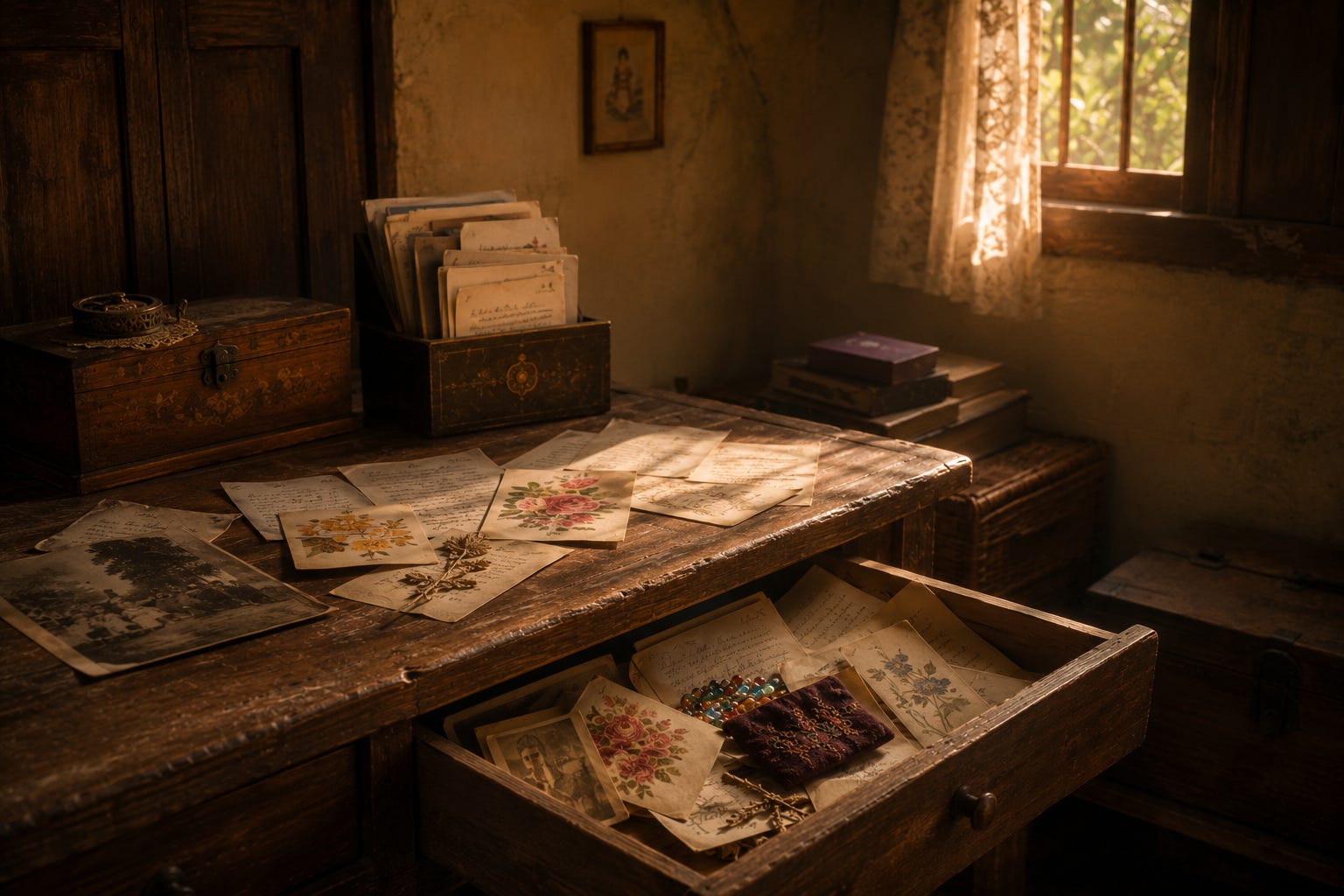
“Achoo!”, six-year-old Aami sneezed as she pulled the drawer open.
The upstairs table had never really interested Aami or her brother until now. They were playing with some of Amma’s old toys when suddenly Aami thought of combing a doll’s hair.
She was looking for a comb.
“Look, look!”, her older brother Dev, eight, was already digging in beside her. “There’s so much stuff in here!”
Aami and Dev had come to their Amma’s home for the holidays. This had been Amma’s study room.
Ammamma always said she had spent half her childhood here—reading, drawing and making things.
The upstairs was now rarely used. Mostly the family just kept to the ground floor.
Dev pulled out a handful of greeting cards, fanning them like a hand fan. Aami found a small velvet pouch and shook it — coloured beads spilled out, clicking and bouncing across the floor before rolling under the bed, the table and the almirah.
Dev held up a dried brown rose. He pressed the crispy edges and it crumbled. There were several handwritten letters, yellow with age, soft at the creases from being folded and unfolded a hundred times, one of which tore slightly as Aami tried to open it curiously, a bit too hurriedly.
“This is boring, just papers”, Dev said, tossing a bunch of old bus tickets over his shoulder like confetti. “Let’s find something else.”
That’s when Nikita walked in.
She stopped in the doorway.
“DA!—”, it came out sharper than she meant it to.
Both children froze, Aami still holding half an empty velvet pouch, Dev with a bus ticket in each hand.
Nikita’s chest was tight. Her eyes went to the greeting cards, bus tickets, a satin cloth and various other things fanned across the table. She was not happy that the cards and papers were bent and crumpled.
The pressed flower was in pieces. The letter had a small tear now, right through a word she didn’t need to see to remember.
“Amma, we were just playing—”, Aami’s voice wobbled, unsure what she’d done wrong.
Dev looked at the ticket in his hand, then at his mother’s face, and quietly set it down.
Nikita opened her mouth to say something about being careful, about asking first, about this-is-not-a-toy — and then she caught herself.
She wanted her children to understand what these things meant to her—not simply be told to leave them alone.
She sat down on the floor, right where she was, cross-legged, the way she used to sit at eight.
“Come”, she said. “Sit with me.”
The children came, uncertain, and sat.
Nikita picked up the torn letter first. Her thumb moved gently over the tear, not fixing it, just feeling it.
“This is from your Ammamma”, she said. “She wrote it to me when I went for my first school trip. I was so scared to sleep away from home. She wrote this and gave it to the teacher to give to me at night.”
“What does it say?”, Dev asked, leaning in.
“That she was thinking of me. That the fear would pass by morning.” Nikita smiled. “It did.”
She picked up a photograph next — Dev, watching now without touching. “This was the Java plum tree in our old house. I used to climb it every morning before school.” She turned it so Aami could see. “See this small girl at the bottom? That is me. I was maybe your age.”
Aami touched the corner of the photo carefully, like it might sting.
Nikita picked up a few beads from the floor that had rolled away and placed them back with the others in the pouch.
“These beads are from a necklace your Achachan brought from Mumbai. There were two—one for me and one for Chechi. I wanted both. I cried so much...” She laughed. “Chechi gave me hers.”
“You make such sacrifices for Aami too, don’t you, Dev?”
Dev laughed.
Then she reached for the crumbled pressed flower, and her hand paused over it a moment too long.
“Amma?”, Aami asked.
“This one is from a rainy birthday”, Nikita said quietly. “A long time ago. It doesn’t matter what happened that day anymore. What matters is I picked this flower right after, and I decided I wanted to remember feeling okay again.”
Neither child understood that fully, and Nikita didn’t try to make them.
She sat there a moment longer, the broken flower in her palm. Dev and Aami looked at each other, seeing Amma stare blankly.
“Amma”, Dev said, breaking her thought, “why do you keep so much old stuff?”
Nikita looked at the mess on the table — the fanned greeting cards, the photographs, the scattered tickets, the torn letter, the broken flower — and for the first time all afternoon, she didn’t feel the urge to put it all back exactly as it was.
“Because none of it is old stuff, mone”, she said. “It’s where I keep the parts of me I don’t want to forget.”
“Okay, how about you choose one thing today. And I’ll tell you its story. Next time we come, you choose another.”
Dev picked up one pink KSRTC bus ticket carefully this time, like it had suddenly gotten heavier in his hand.
Nikita laughed. “This!”, she drew in a long breath, still smiling. “This was the ticket from a bus I travelled with your Achan before our marriage, after our marriage was fixed. We got on the bus only to discover half the bus knew Achachan, so we spent the whole journey sitting on opposite seats. Don’t tell Achachan and Ammamma.”, and Nikita let out a laugh again, feeling silly.
Nikita didn’t refill the drawers that evening. She left them open, a little more emptied out onto the table than before, a little more shared than kept.
Some things, she was learning, were meant to stay safe.
But some were finally meant to be told.
❤️
Ann’s Insights
How did you enjoy this story? When that pressed flower crumbled, I literally gasped.
When I’m working with clients, the sentimental items are left until the very end because in that phase of the process, we’re no longer organizing objects, we are sorting through memories.
What strikes me about this story is that the drawer full of letters, photographs, and pressed flowers wasn’t neglected. Nikita hadn’t forgotten those things were there. She just hadn’t been ready to face them.
I do appreciate how Nikita resisted the urge to scold the kids. Instead, acknowledging that the children played innocently, she chose to tell the meaning behind the things she’s been holding on to, which immediately captured their attention. That’s exactly what sentimental items are for, to connect us with the emotions that had significance and pass down stories of lived experiences that shaped us into who we are.
When it comes to sentimental items, a few things worth keeping in mind:
How you store something sends a message. Items tucked away in an overstuffed drawer can signal to others that they aren’t precious. Displaying or storing them with intention communicates their value. (Imagine a simple ribbon and bow around saved letters placed in a nice box.)
The story matters more than the object. If letting go feels hard, try sharing the memory first. Sometimes that’s all it needs.
Items that get damaged or deteriorate through age can be respectfully let go. It helps to send a wish or thoughts of gratitude to the object, the person, or the memory then let it go responsibly.
What’s something you recall from your past you have trouble letting go of? We’d love to hear from you in the comments. Next week, we look forward to introducing you to Raghu, the Collector.

Hi Sheeba,
I loved your way of story telling. i also write short stories for children. Stories that trust readers to find their own meaning. i hope you give a read.
https://nehagoud.substack.com/p/atharv-and-dia?r=8mdwb4
https://nehagoud.substack.com/p/real-indian-stories-for-real-indian?r=8mdwb4
oh my god! i loved the story. I love how the mother didnt scold their children instead wired them to a different thought. i write such stories too but for early readers. stories that will make the reader pause and think for a moment. i hope you give a read. Thank you so much
https://nehagoud.substack.com/p/atharv-and-dia?r=8mdwb4