



Some children see possibility where others see mess. This week Sheeba of This, Right Here, a gifted writer who once again brings us into a South Indian home, and paints another picture we can feel in our hearts. And allows me the honor of adding my perspective as a connection-first home organizer and parent educator to bring the story full circle.
If you missed last week’s story about Raghu the Collector, I hope you’ll have a chance to read it. For now, let’s continue with today’s story.
Shreya, the Creative Child.
by Sheeba
Shreya walked home from school the long way, which meant past the empty plot where the grass grew wild and nobody minded if you stopped and looked.
Something shiny caught her eye. She crouched by the fence and turned it over in her palm— a curved piece of blue glass, edges rounded smooth by time, not sharp at all. She held it up to the light. A patch of blue fell across her cream uniform, its edges breaking into tiny rainbows.
“Ayyo, look at this!”, Meera said, from just behind her, and for one second Shreya thought her friend meant the glass.
But Meera was looking at Shreya’s bag, not the glass. The zip was half open, and things were spilling out at the seams — a spool of red thread, three buttons of different sizes, a big dry mahogany seed pod, a bent bit of wire twisted into something like a spiral, a smooth grey stone with a white ring around it.
“You look like a kuppi-paattakkari—a rag-picker. Why do you carry all this junk?”, Meera said, laughing, and the two other girls with her joined in teasing her.
“It’s not junk”, Shreya said quietly, closing her bag.
“Garbage girl”, Ammu taunted, and it stuck, because Ammu was good with words that stuck. Meera and the others laughed harder now, singing in unison “Garbage girl, Garbage girl” and Shreya kept walking, faster, the blue glass still warm in her closed fist.
At home that evening, Valsala aunty from next door saw Shreya crouched near the drain outside the compound wall, picking something out from between the stones.
“What is it now, digging in the drain like a crow?”, Valsala aunty called out, not unkindly, but not kindly either. She was Meera’s grandmother.
“Revathi”, she said to Shreya’s mother later, over the wall, loud enough for Shreya to hear from the veranda, “your daughter is collecting all kinds of rubbish. People will talk. Also, she may catch some disease!”
Shreya sat very still on the veranda step, the new find — a small brass button, green with age — cooling in her palm.
Her mother came and sat next to her.
“Amma, is it rubbish?”, Shreya asked, not looking up.
Her mother took the brass button and turned it over. It had a rose engraved on it. “It’s a button,” she said. “What do you think it is?”
“I don’t know yet,” Shreya said. “I’ll know when I see it next to the others.”
Her mother nodded with a smile and got up to take the dried clothes on the clothesline.
“Then keep it,” she said. “You’ll know.”
That was all. No more questions.
In the evening Shreya’s father, coming in from the shop, added a small tin box to her table. “For the small ones, so they don’t get lost,” he said, and nothing more.
One day, the school announced an arts and science exhibition — students could bring anything related to arts, languages, science. Things they had made themselves.
There would be prizes in each subject for the most innovative exhibit.
The children started chattering among themselves. Exhibits could be made alone or by groups. Shreya sat silently, thinking.
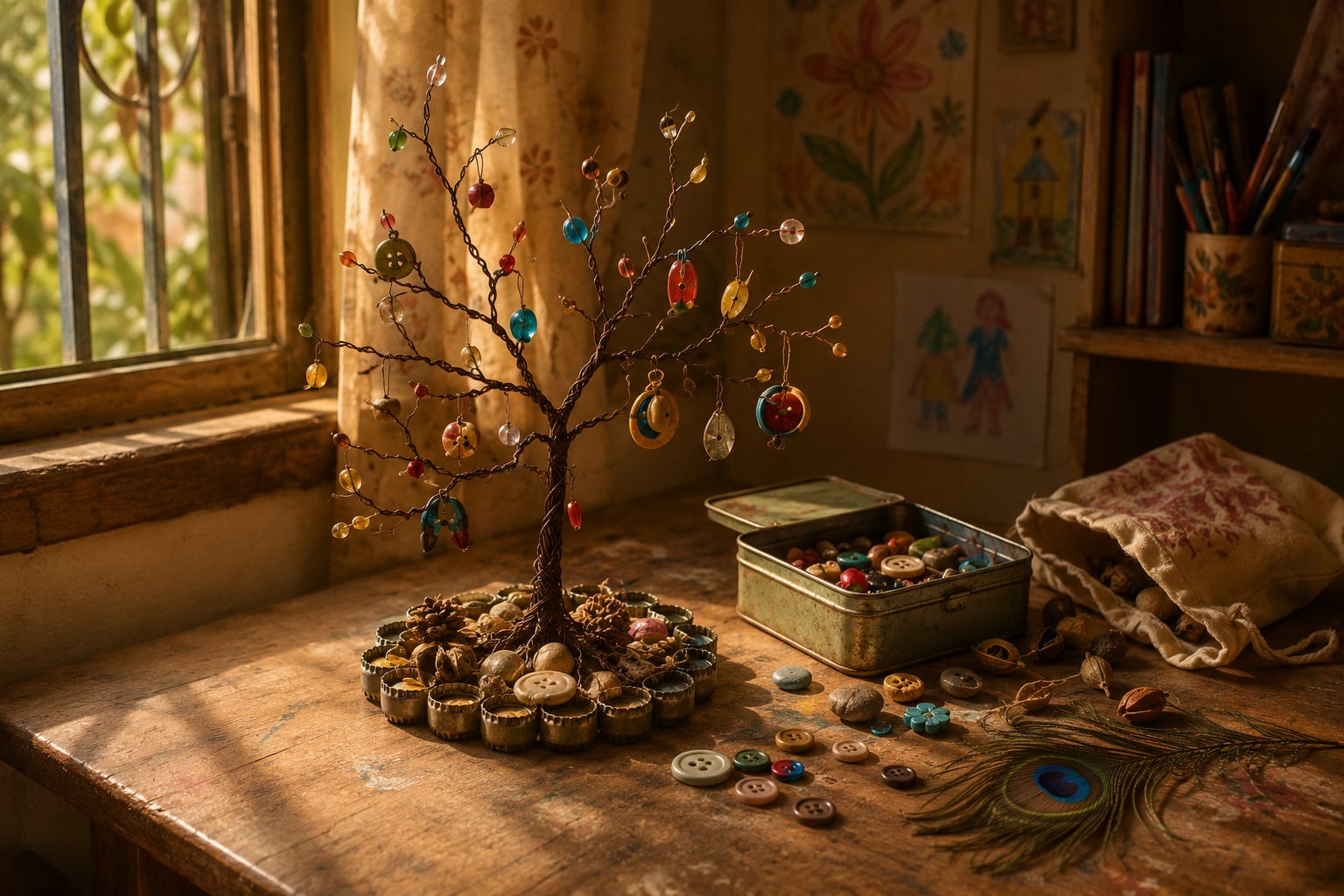
Shreya started working on her exhibit every day after school. The exhibition was two weeks away. She would sit near the window, sorting through the tin box, the cloth bag, the drawer that had slowly filled over the year — glass, buttons, seed pods, wire, stones, a fallen peacock feather from Ammamma’s garden, soda bottle caps flattened smooth by wheels on the road.
She built a tree.
A standing one, twisted wire for trunk and branches. Slowly it took the shape of an old majestic, gnarled tree. Shreya added long pearls and painted pistachio shells for the leaves.
She hung several glass pieces and buttons she had found over the years. It looked like beautiful little fruits in multicolours. For the ground around the tree she added a border of flat soda bottle caps. Finally she added a thin strip of LED light that she had got from Biju uncle’s house that he had not wanted.
When the lights came on, the tree seemed to come alive. The fruits dazzled as a tiny breeze swayed them.
It had taken her four evenings. Her mother would bring her milk and biscuits and leave it on the table without a word. Her father fixed the wire frame once when it wouldn’t stand straight, and then stepped back and let her finish it herself.
On exhibition day, Shreya carried it to school wrapped in an old dupatta, holding it flat against her chest the whole bus ride, terrified of a single branch bending.
She set it on the table assigned to her, between Meera’s neat papier-mâché globe and someone else’s model volcano, and stood behind it, waiting.
Meera walked past first, and stopped.
“Shreya... is that—”, she leaned in close to the blue glass hanging from the branch, “—is that from the plot near the fence?”
Shreya nodded, not sure if this was the start of more laughing.
But Meera didn’t laugh. She was looking at the whole tree now, slowly. The twisted branches stretched out imperfectly. It looked as though it were growing, not made.
A teacher stopped next, then another, then a small crowd of parents drifting from table to table the way crowds do, until there was a proper cluster in front of Shreya’s tree, someone asking “what is this made of,” and Shreya, for the first time all day, finding her voice.
“Everything is something I found,” she said. “A button, a stone, glass pieces, pistachio shells. I just had to wait until I knew where each one belonged.”
Valsala aunty was there too, and she stood at the edge of the small crowd a long moment, looking at the tree, saying nothing this time.
Shreya’s mother stood near the back, not pushing forward, just watching her daughter answer questions with a steadiness that hadn’t been there a year ago. Her father took a photo on his old phone, the tree slightly blurred, Shreya smiling and it remained his favourite photo of her for years after.
Walking home that evening, Meera fell into step beside Shreya, quiet for a while.
“I still don’t understand how you knew,” Meera said finally. “How did you know the glass would look like that, hanging there?”
Shreya thought about it. “I didn’t,” she said. “I just kept it until it told me.”
Later that evening, Shreya caught a glimpse of Meera’s hand reaching through the open window. By the time she ran to the door, Meera was already halfway across the yard.
Shreya found a crumpled paper on her table. She slowly opened it. Inside were three beautiful glass marbles and a toffee, with a note.
“Next time we collect together. Ok?”
❤️
Ann’s Insights
How did you enjoy this story? Shreya is the child I wish every parent could see before they say the word “junk.”
What looks like a collection of garbage to one person is raw material to someone who sees differently. Shreya didn’t know what the blue glass would become when she picked it up. She just knew it mattered. And she was right.
What her parents did beautifully was hold space without needing to understand. Her mother answered a question with a question. Her father added a tin box without a lecture. Neither of them needed to see the vision to trust it. That kind of support is rare and worth naming.
When I work with creative children and their families, organizing the collection matters as much as honoring it. Creative children are often inspired by material before they know what it’s for — and that’s not a problem to solve, it’s a process to support.
But a collection is only useful when you can find what you need. Here are a few things that help:
Create zones by material. Separate things like fabric, paper, metal, natural objects and store them in a way that preserves their condition.
Use containers that make sense for the contents. A pull-off lid for small beads leads to spills. A screw-on lid doesn’t. Let the material tell you what it needs.
Label in a way that works for your child. Not every container needs a text label. A sample of the material glued to the outside works just as well, sometimes better.
Designate a spot for works in progress. A tray or caddie for an unfinished project means your child can pick up where they left off without starting over or losing pieces.
The goal isn’t a tidy craft room. It’s a space where a creative child can find what they need, when the idea arrives.
What did this story bring up for you? We’d love to hear in the comments. Next week we introduce you to Riya, the last character in our series — and perhaps the most relatable of all.
Thank you so much, Lara❤️❤️
Thank you so much for sharing!