



Here we are again, for week three of a five part series I'm doing with Sheeba of This, Right Here, who writes the kind of stories that stay with you after you've finished reading.
Each week she brings a fictional story inspired by South Indian family life, and I add my perspective as a connection-first home organizer and parent educator, to help shed some light on the challenges of letting go and holding on.
If you missed last week’s story about a mother sitting with a drawer full of memories she wasn’t ready to open. I hope you’ll have a chance to read it.
Enjoy today’s story, and Sheeba and I look forward to hearing your thoughts on it.
Raghu, the Collector
by Sheeba
Nine-year-old Raghu stood outside Sudhakaran uncle’s busy little shop in a narrow Mumbai lane, shifting from one foot to the other on the sun-warmed pavement.
A few people had gathered around to buy a cup of tea before hurrying to their jobs.
In front of the shop, a colourful line of magazines swayed overhead with rusty steel clothespins. The Week. Vanitha. Mangalam. Tinkle. Chandamama. Amar Chitra Katha. Phantom. Their colourful covers fluttered whenever a BEST bus rumbled past at the end of the road.
He wasn’t there to buy one of those.
He never was.
Raghu was there to buy a packet of bread and half a dozen eggs.
He read standing up, eyes racing across the pages before Sudhakaran noticed.
“Ay, kutta! This isn’t a library!”
Raghu grinned, closed the comic exactly where he’d reached, and stepped away.
He bought the things he had come for and ran home. He knew that tomorrow he would come back and begin from that page.
At home that evening, his father sat at the dining table with a steel tumbler of tea, going through account books from the textile shop.
“Achaa...”
“Hmm?”
“Can I buy one comic? Just one. Five rupees.”
Achan didn’t even look up.
“Five rupees for a storybook? Go study your maths. When you start earning, buy a hundred comics if you want.”
Raghu nodded.
That was the end of the conversation.
Or at least it looked like it.
That night, lying on the floor beside the open window, Raghu tried doing the arithmetic anyway. Outside, buses groaned, scooters honked and cars streamed past. The city never slept. But Raghu hardly noticed.
Two rupees saved this week...
Two next week...
One more...
Except Amma would need change for vegetables.
Or there would be school notebooks.
Or someone would ask why he was hiding coins.
The little pile in his mind always disappeared before it became a comic.
He never owned a brand new one. Once in a while he wandered into Dheeraj bhaiyya’s raddhi shop. Between old newspapers and school textbooks would be a torn Phantom, a faded Tinkle, an Amar Chitra Katha missing its back cover. To Raghu, they were treasures. Sometimes he hit the jackpot with a collector’s edition.
He would hide them safely at home. Sooner or later, Achan would discover them during a cupboard cleaning and send them off with the next bundle of old papers.
Raghu grew up reading them one visit at a time, outside Sudhakaran’s tea stall, until one day the comics stopped appearing overhead.
Just as quietly, the tea stall disappeared.
And eventually, the lane itself looked different.
Some memories leave so quietly you don’t notice they’ve gone until years later.
----
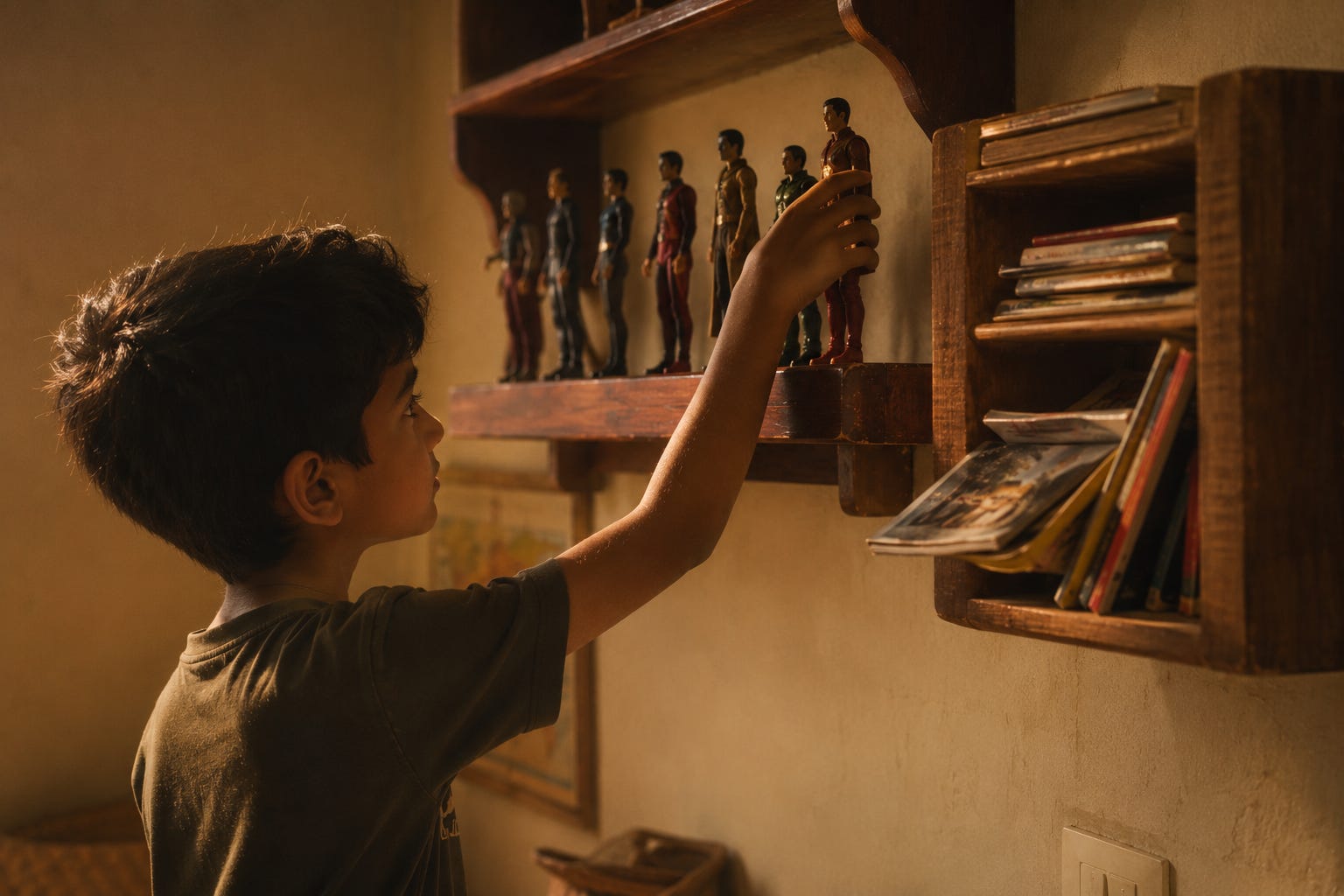
“Achaa, look, look, I got Iron Man’s whole team now!”, seven-year-old Vidhu came running into the hall, holding up a small red-and-gold figure still in its blister pack, joining a small army already lined up on his shelf — a shelf Raghu himself had put up just for this, three tiers, good lighting, exactly like a shop display.
Vidhu had a version of everyone. Some limited edition, some ordered specially from a shop two towns away, some that Raghu had waited weeks to find.
Vidhu liked them well enough — he played with them, arranged them, occasionally lost interest for a month before circling back — but it was Achan who knew the checklist by heart, Achan who got a small thrill each time a gap on the shelf closed.
That evening Raghu helped him peel the packaging carefully, sliding the figure out without bending the small plastic sword in its hand.
“There”, Raghu said, setting Iron Man in his spot on the shelf, third row, next to Thor. “Complete set now, all six.”
Vidhu looked at the shelf, pleased in the simple way children are pleased, and then looked up at his Achan, who was still looking at the shelf like it meant something more.
“Did you finish reading this comic?”, Raghu reached over Vidhu and picked up a Ultimate Spider-Man.
He smiled at a passing thought that Spiderman was also a family man now, like him.
Vidhu looked at Achan who was glossing over the comic.
“Achaa, you also like reading comics?”
Raghu laughed a little, caught out. He sat down on the floor next to his son.
He told his son about Sudhakaran uncle’s shop, the raddhiwalas, occasional tradings and borrowings of comics from friends.
“Brand new comics were expensive. Achachan said it’s a waste — go read your school books instead.”, Raghu turned over the comic in his hand and chuckled at the price.
“Never had a shelf like this.”
Beside the action figures stood another shelf, its comics stacked untidily, a Spider-Man sticking out from between a Tinkle and an Amar Chitra Katha.
Vidhu looked where his achan was looking. His own shelf — multiple sections with lighting and neatly arranged.
“You can have one”, Vidhu said finally, reaching for Thor.
Raghu smiled and shook his head, putting Thor gently back in his place. “No, no. This one is yours. I’m just happy to keep finding them for you.”
But that wasn’t quite the whole truth, and some part of Raghu knew it, sitting there on the floor of his son’s room, forty years old, looking at a shelf that had never once had a gap he couldn’t eventually fill.
Every figure he found for Vidhu, every comic he added to the shelf, quietly answered the wish of a nine-year-old boy who had once stood outside Sudhakaran uncle’s shop reading as fast as he could before someone told him to move along.
He smiled at the comics and story books spread on the bed and study table, along with the textbooks and notebooks.
And then at his son who was holding a spider man figure and reading the comic, hands supporting his chubby cheeks.
❤️
Ann’s Insight
Having married a collector whose father also collected, this story is close to my heart.
The things on Raghu’s shelf weren’t just things his father helped to collect. It was an unfulfilled childhood dream that his father couldn’t let go of, and was living vicariously through his son. A shared joy, to finally have the independence and means to display the things they both love.
When I work with children with a passion to collect, there are a few things I’m mindful of:
I always honor their collection even when the parents are frustrated with the accumulation. Curiosity and passion are worth taking seriously, even when the interest seems small or impractical. Understanding why it’s important to the kids builds trust. And if the child is taking care of their precious collection, and there’s enough room for it (or if they are willing to let go of other things to make room) sharing that passion becomes a way to bond with your children, letting them feel seen, heard, and respected.
But saying yes doesn’t have to mean unlimited. If a full shelf with no gap means toys start to fall down when you try to reach for one, then it’s telling you there are too many. Just like a museum or store display, each item deserves room to shine.
Help your child practice discernment and patience. Two old sayings come to mind:
“If everything is special, nothing is.”
Have the kids rank their most to least favorite character as a way to help them understand more is not better.
”Anything worth having is worth waiting for.”
A child can save birthday money, or contribute beyond their usual responsibilities to work toward something they really want. That process builds patience, value, and appreciation.
What did this story bring up for you? We’d love to hear in the comments. Next week, we look forward to introducing you to Shreya, the Creative Child.
What a truly beautiful collaboration! Sheeba’s incredible storytelling skills merged with Ann’s unique ability to see what lies behind the scenes is just wonderful. It’s such a powerful post, and I think everyone can find a piece of themselves in it. However, the realization of how one’s absence highlights the other’s presence—and how value sometimes goes unrecognized—truly aches my heart. Thank you both for sharing such a deeply touching piece. 🌸✨
Hey
I like the collab by both of you👍
This small story is so soothing to read as we can easily relate to 🙂↕️🙂↕️🙂↕️🙂↕️
Great job guys 👍